
The History of Sherborne House - Part 3
Sherborne House Sold
In 1798 Sherborne House was inherited by Henry but advertised as for sale in April of this year. A 'Bill of Sale' listing the contents of the house survives including 'a fine-toned double harpsichord by Shudi, a single harpsichord by Kirkman, and a spinnet by Harris in a mahogany case ...' The House was bought by the Digby family.
During these later 18c decades the House was let out to tenants until finally, it was leased for one year at a peppercorn rent to a wealthy farmer, James Toogood, then aged 47 in 1799, and who then bought the House from the Digbys. We learn that he purchased that 'Capital Mansion House' and its grounds for £2,900. ' ... handsomely built with roomy commodious apartments ... granary, coach-houses and stabling for 30 horses with rooms over them ... and about 5 acres of pleasure ground, and good gardens adjoining ... well planted with fruit trees ... likewise in separate lots, several Closes containing about 30 acres of very good meadow land contiguous to the premises.' . Suggested here is that tract of land north and east of the House, listed as Newlandes on the c1570 map (see above).
At the time of sale the tenant was one Miss Esther Warwick who had advertised a Ladies Boarding School in the Universal British Directory for 1790-98. Another tenant was one Dr Cuthbert Johnson MD. He moved to Sherborne from the north by1774 and is recorded in Sherborne Medical Registers for 1780 and 1793.
James Toogood had two older clergymen brothers, John and Charles (one-time curate of Sherborne), and his brother -in-law and cousin, William Toogood had recently built a handsome mansion near 'New-well Water' (latterly Newell House School). The Toogoods were a well-known local family, there are Toogood papers in Dorset Record Office. James' father John Toogood was a governor of the King's School from 1746-1789 and wrote a history of the school from 1550, a manuscript copy of which survives. He repaired the Abbey barn, now Abbey Grange, the present Headmaster's House. The Toogoods also set up a trust for the repairing of 'Sherborne Parish Church' [now known as The Abbey].
In May 1850 Macready signed the lease paying £50 p.a. for house and garden excluding the plot on the other side of Newland. He was to much enjoy the kitchen garden. He had previously thought of retiring to America which he had visited in 1848 but found the Newspapers in particular 'vulgar and coarse.' The (newly launched) Sherborne Mercury which records Macready's arrival in Sherborne and the paper continued to be a model of reporting throughout the 1850s and has much to tell us about what was to become known as the Macready Literary Institute. This is the decade which witnessed the beginning of what we might now term as ‘mass [printed] media’ and one which was to inspire ‘scrap-book’ making; the collage presented by the remarkable survival of what s has become known as the ‘Macready-Dickens Screen’ is eloquent witness as to the scale of what was to be inspired by this. And which has recently been restored and on display in the Collage Exhibition in Edinburgh (see the publications listed below).
The House in the Nineteenth Century
In 1805 William Lord Digby drew up an Indenture with the Brethren of the Almshouse to finance the venture started by his wife Lady Jane Digby. The charity school was appropriately endowed, the leaving age fixed at 14, and the premises made available in 1745 are those today occupied by the Britannia Inn in Westbury. There remains a stone foundation plaque on the wall to record this.
James Toogood died in 1816 and his brother Charles then sold the House back to the Digby family, to Edward, 2nd Earl Digby for £2,000. And then for more than a century it continued to be leased out. The Digby tenants included Samuel Pretor, a banker, Robert Willmott, a silk manufacturer, Miss Armitage who ran a school and Major Bogle who won a Victoria Cross during the Indian Mutiny.
The Digbys did not live in Sherborne House and, from now on, we find a list of tenants, records of whom are to be found in Sherborne Castle archive.
Miss Grace Armitage, a schoolmistress was the first tenant and she is listed in the Directory of 1823-4 as running a Ladies Boarding Establishment. She first appears in the Castle Estate Rent Book for the year ending 1819, paying £50. Through ill-health it seems, she sold the lease in 1823 to Jane Lawrence Carige and Patrick Chalmers of Stockbridge, while remaining on the premises 'her bedroom, her dressing room and a sitting room called the Tapestry Room.'
And in 1823 a seven year lease was drawn up between Earl Digby and Samuel Pretor, a local banker - Pretor's Bank was in Long Street. Pretor paid Digby £72 pa as rent. And in 1831 Samuel Pretor married Frances Dowding of Ansford Park Farm part of which is sold off to the Great Western Railway Company.
The beautifully coloured map of Sherborne drawn by Edward Percy in 1834 is accompanied by a terrier, or list of lands, from which we learn that Sherborne House was still held by Samuel Pretor from Earl Digby. The gardens are shown in some detail, including the now 'lost' kitchen garden to the north-west of the House that lay between the Stable block and Coldharbour. And which - until the recent building development presented overgrown flower and vegetable beds - and unmanaged apple trees.
The 1841 census records the occupants of Sherborne House as Samuel Pretor, 48, and his wife Frances, 29, with four children aged 9, 8, 6 and 1 and two male and four female servants in residence. In 1849 the Pretor family moved to Fleet House in East Fleet.
William Charles Macready
On 4 August that year, ‘William Charles Macready, the famous Victorian actor visited Sherborne by way of Dorchester . . .'walked over Castleton, went into a house - Sherborne House - which was selling off.' He described it as 'old-fashioned' but that 'a very cheap rate might suit us.' We are given to understand here that the Portman mansion had received little by way of repairs or improvements over the years.
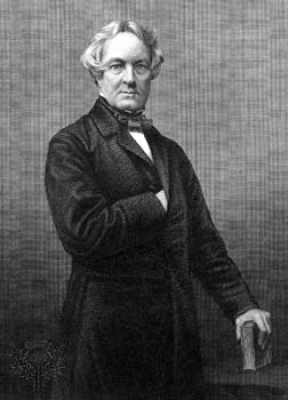
In May 1850 Macready signed the lease paying £50 p.a. for house and garden excluding the plot on the other side of Newland. He was to much enjoy the kitchen garden. He had previously thought of retiring to America which he had visited in 1848 but found the Newspapers in particular 'vulgar and coarse.' The (newly launched) Sherborne Mercury which records Macready's arrival in Sherborne and the paper continued to be a model of reporting throughout the 1850s and has much to tell us about what was to become known as the Macready Literary Institute. This is the decade which witnessed the beginning of what we might now term as ‘mass [printed] media’ and one which was to inspire ‘scrap-book’ making; the collage presented by the remarkable survival of what s has become known as the ‘Macready-Dickens Screen’ is eloquent witness as to the scale of what was to be inspired by this. And which has recently been restored and on display in the Collage Exhibition in Edinburgh (see the publications listed below).
Macready had eight surviving children; the youngest were Lillie, 8, and Cecilia, 4; his wife was Catherine, and they lived with her sister, Letitia. His two sons, Edward and Walter were entered at the King's School; the younger boy then aged 10, died in 1853. Both were removed after their father refused to pay a penny fine the Headmaster had levied from the whole school to replace a badly damaged book. Macready was not complimentary about Sherborne which he described as ‘a dreary place.’ The year 1852 saw the publication of the Public Health Report on the stinking state of Sherborne's water supply and sewerage. Mains water and sewerage were to be installed over the next two years.
The Literary Institution Minutes record the discussion on the installation of a Water Closet which following the proposal that, with the new drains safely in place, this should be sited ‘indoors.’ Macready commented that ‘this would be disgusting . . . ’ And to this day there remains a WC located in the dividing wall between Sherborne House and the Antiques Emporium. The fittings have, of course, been ‘updated’ but this must be one of the oldest recorded Water Closets in this area – if not in Dorset. And sometimes feel this merits a ‘blue plaque.
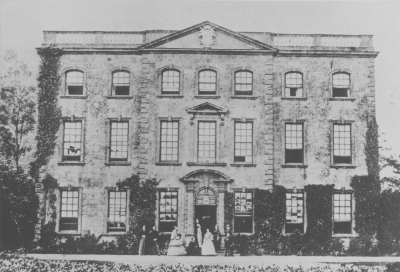
The 1851 census lists the whole family plus four servants - housemaid, cook, nurse and a footman. There is an undated photograph taken of 8 members of Macready's family posed outside Sherborne House presumably before Walter's death in 1853. The youngest child, a boy, born in 1850, is not in the picture; one of the four women could be Macready's wife if the picture was taken, as it seems, during the summer. A coat-of-arms is shown in the pediment of the house - probably Portman/Fitch. Macready's wife died in the September.
In 1851 Macready subscribed to the fund set up by Hugo Daniel Harper, Headmaster, to enlarge the King's School, who effectively created the independent school of today. In the first (surviving) Minute Book of the Sherborne Literary Institution; Macready is listed as President. In 1853 work started on the refurbishment of the Sherborne House stable block as the new - and permanent - premises for the Sherborne Literary Institution. Today occupied by the Antiques Emporium, the original mid-Victorian roof structure is still in place.
'The New Rooms' were formally opened on 26 June 1854, we find an excellent write-up in the Sherborne Mercury; Macready is described as 'the re-generator' of the Institution. An annual programme of lectures, musical recitals, weekly/evening classes, etc is re-established. In July, John Penny, a local bookseller, presents a large glass-fronted bookcase to house the growing collection of books for the Institution reading room. This was very much a decade of ‘improvement’ one in which Prince Albert was to play an important part. But not to omit mention those Mercury reports on the hunger riots in Sherborne the previous January and the emergency soup kitchen set up. And literacy in the Sherborne area was low; the Elementary Schools Act was not passed until 1870s.
The Literary Institution Minute Books stored in the Dorset History Centre provide detailed accounts of each of the committee meetings – a unique ‘window’ on the Sherborne House ‘world’ of the 1850s and includes the names of all the many speakers invited to Sherborne; Macready’s London ‘connections’ were valuable indeed – speakers given accommodation in Sherborne House. The railway did not open until 1860 – anyone travelling by rail needed to take a carriage to (and from) Frome.
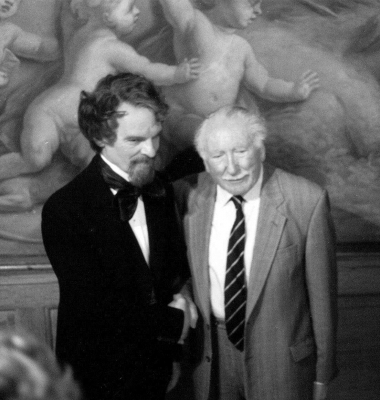
On 20 December 1854, Charles Dickens, friend of Macready and godfather to one of his sons, gave a reading at the Institution. Money was raised for buying more books. And it was in 2004, the Friends of Sherborne House held a memorable Reading – in the House - given by the actor John Flint and attended by Charles Dickens’ grandson, Cedric Dickens.
The Literary Institution also acquired a major collection of geological specimens and fossils. Following its closure in 1892 no one knows what became of these – or the many books.
By 1860 three of Macready's children now dead in Sherborne only three remained at home and he left the town for Bristol - where he re-married.